Basic concepts for understanding the subject of heat transfer.
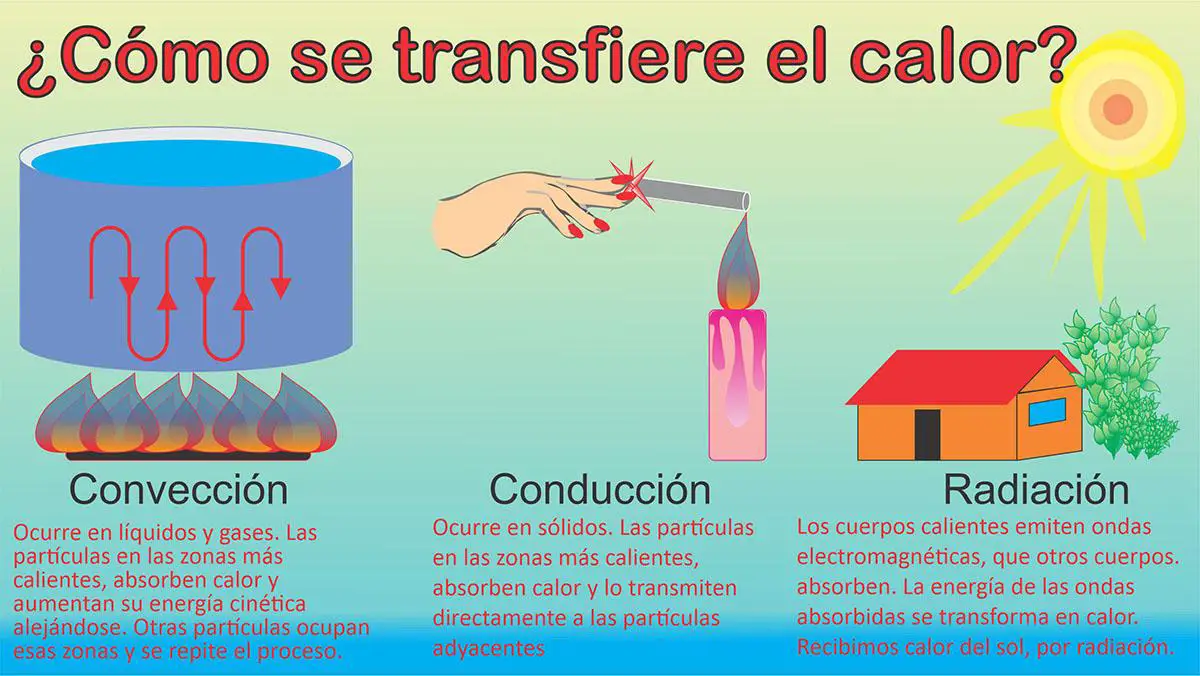
Convection
noun
Heat transfer in a fluid by movement of unevenly heated layers
Example: The liquid portion heats rapidly by CONVECTION and transfers the heat into particulate by conduction.
en: Convección
Convection resistance
noun
Convection resistance can be defined as the inverse of the convective heat transfer coefficient per unit area.
Example: This is the resistance to surface convection. As the convection coefficient h increases, the resistance will decrease.
en: Resistencia a la convección
Critical radius
noun
The Critical Radius is precisely the measure of the radius of an insulator at which the heat transfer is where the heat transfer is at its maximum or the heat flow resistance is very heat flow resistance is very low, so that when placing an insulating insulating material should be verified that the external radius of the external radius of this is greater than the critical radius or that the critical radius is less than the radius of the critical radius is smaller than the outer diameter radius.
Example: The critical radius depends on the thermal conductivity of the insulating material and the insulating material and the heat transfer coefficient (h). heat transfer coefficient (h).
en: Radio crítico
Efficiency
adjective
Ability to dispose someone or something to achieve the proper performance of a function.
Example: Any problems arise within the firm will affect its EFFICIENCY and in turn reduce the profit.
en: Eficiencia
Fin effectiveness
noun
EFFECTIVITY of a fin is the ratio of the thermal power ( Q-point ) dissipated in the fin to the thermal power dissipated without a fin from the area of the base that the fin occupies on the primary surface: ... -- If EFFECTIVITY = 1 the fin does not affect the heat transfer rate.
Example: Fin effectiveness (ɲ) as the ratio of the heat actually transferred to the heat transferred by a fin
en: Efectividad de las aletas
Fin efficiency
noun
The efficiency of a fin is the ratio of the heat (Qf) that is transferred from a fin at given conditions to the maximum heat transfer (Qmax) that would exist if that fin were at the maximum temperature (the base temperature).
Example: Fin efficiency and a model for the pure heat transfer coefficient, which are applicable when bodies are subjected to a heat source.
en: Eficiencia de las aletas
Insulation
noun
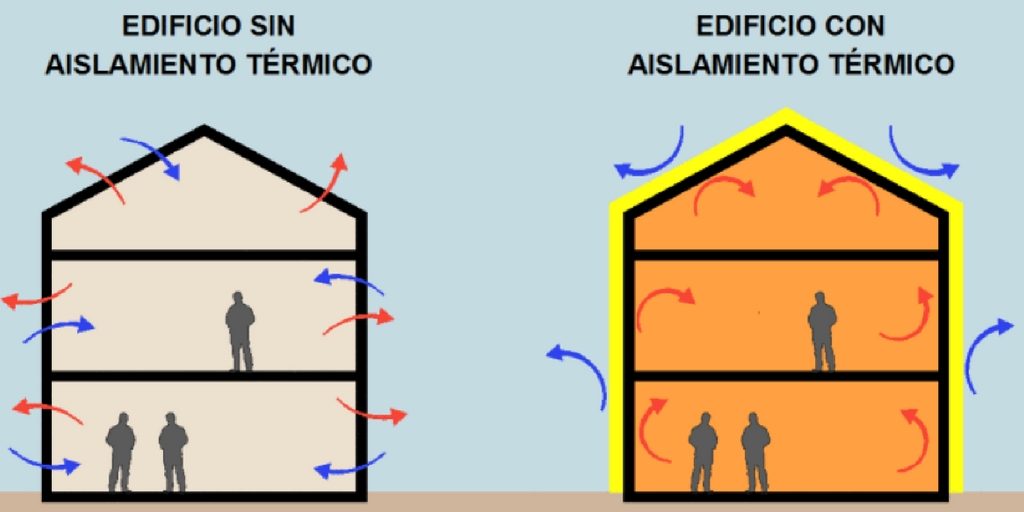
Thermal insulation is the set of materials and installation techniques applied to the construction elements that separate an air-conditioned space from the outside or from other spaces in order to reduce heat transmission between them.
Example: Wall systems (Ching, 2001b) columns and walls, glass construction and masonry walls pre-cast concrete wall panels, concrete framework, concrete columns Connections Pre-cast concrete connections used between the elements (Ching, 2001c) Roof systems reinforced concrete roof slabs pre-cast concrete roof systems Services Thermal INSULATION (Ching, 2001d).
en: Aislamiento (termico)
One-dimensional
adjective
It has only one dimension.
Example: Littler criticises Braverman for this ONE-DIMENSIONAL analysis.
en: Unidimencional
Radiation resistance
noun
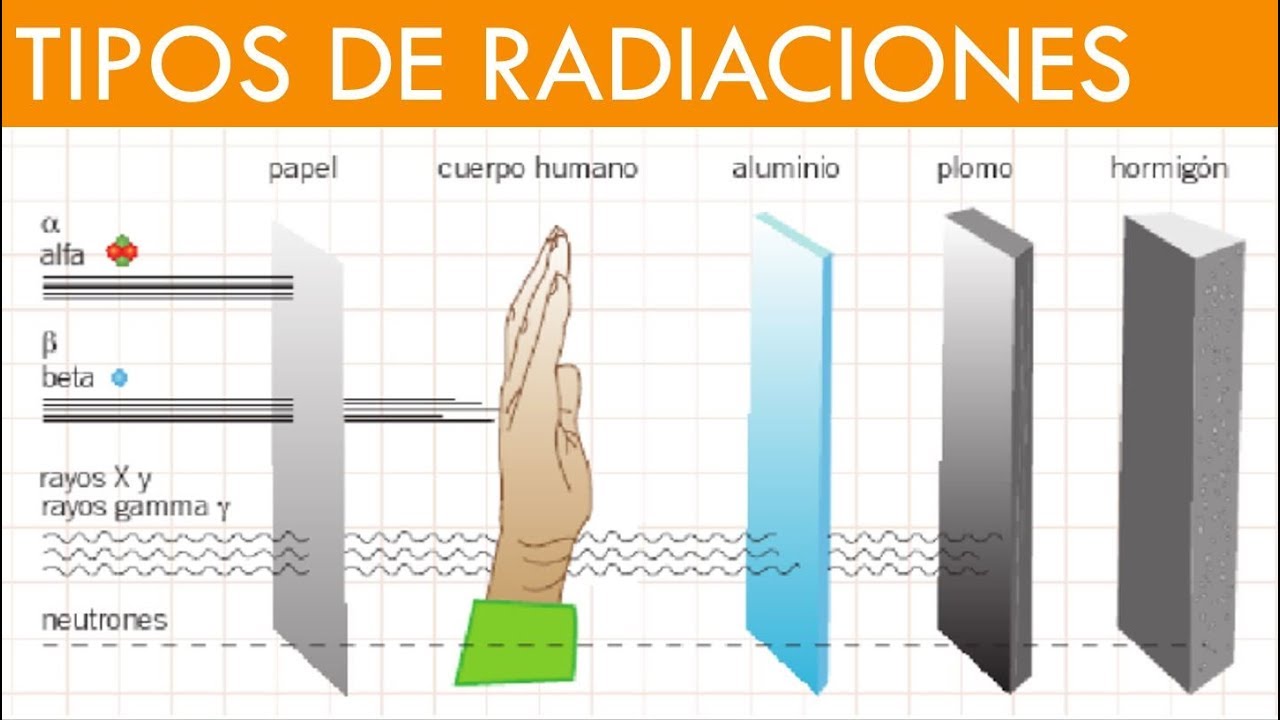
Radiation resistance is the act of manufacturing electronic components and systems that are resistant to damage or malfunction caused by ionizing radiation (high-energy electromagnetic and particulate radiation), such as those occurring in outer space.
Example: Materials such as PEEK and polyamide have good resistance to radiation and X-rays.
en: Resistencia a la radiación:
Resistance
noun
Resistance is a measure of the opposition to current flow in an electrical circuit. Resistance is measured in ohms, which are symbolized by the Greek letter omega (Ω). ... Conductors: materials that offer very little resistance, where electrons can move easily.
Example: Bodies such as the Weed RESISTANCE Action Group (2003) therefore advocate the rotation of herbicide groups.
en: resistencia
Surfaces
adverb
A surface can be defined as a set of points of a Euclidean space that forms a three-dimensional topological space, which locally, i.e., viewed closely resembles the two-dimensional Euclidean space.
Example: Thick cuticles; reduced transpiration SURFACES; and dead hairs covering the stomata, also aid in keeping water loss to a minimum.
en: Superficies
Temperature drop
noun
Temperature quality is defined as the sudden decrease in temperature in a body caused by such circumstances to which the body is subjected.
Example: Temperature drop (T1−T2) is a direct indication of energy extracted. For a given resource, it is dependent on T2 which is in turn dependent on the minimum temperature of the process Ti.
en: Caída de temperatura
Thermal contact conductance
noun
Is a property that indicates the thermal conductivity, or ability to conduct heat, between two bodies in contact. The inverse of this property is called thermal contact resistance.
Example: In thermal engineering, the thermal contact conductance [W / m 2 .K] or thermal contact resistance [m 2 .K / W] represents the heat conduction between two solid bodies.
en: Conductancia del contacto térmico
Thermal resistance
noun
The thermal resistance of a material represents the ability of the material to oppose the flow of temperature. In the case of homogeneous materials it is the ratio between the thickness and the thermal conductivity of the material.
Example: The dominant THERMAL RESISTANCE in compact heat exchangers occurs on the airside, and fins are used to reduce this THERMAL RESISTANCE and improve the heat exchanger overall performance.
en: Resistencia térmica
Total thermal resistance
noun
The total thermal resistance would be the sum of each of the thermal resistances of each material.
Example: The total thermal resistance (RT) is an indicator of how much the enclosures oppose heat flow through them.